Airbnb Co-Host vs Property Manager: Which Is Better for Owners?
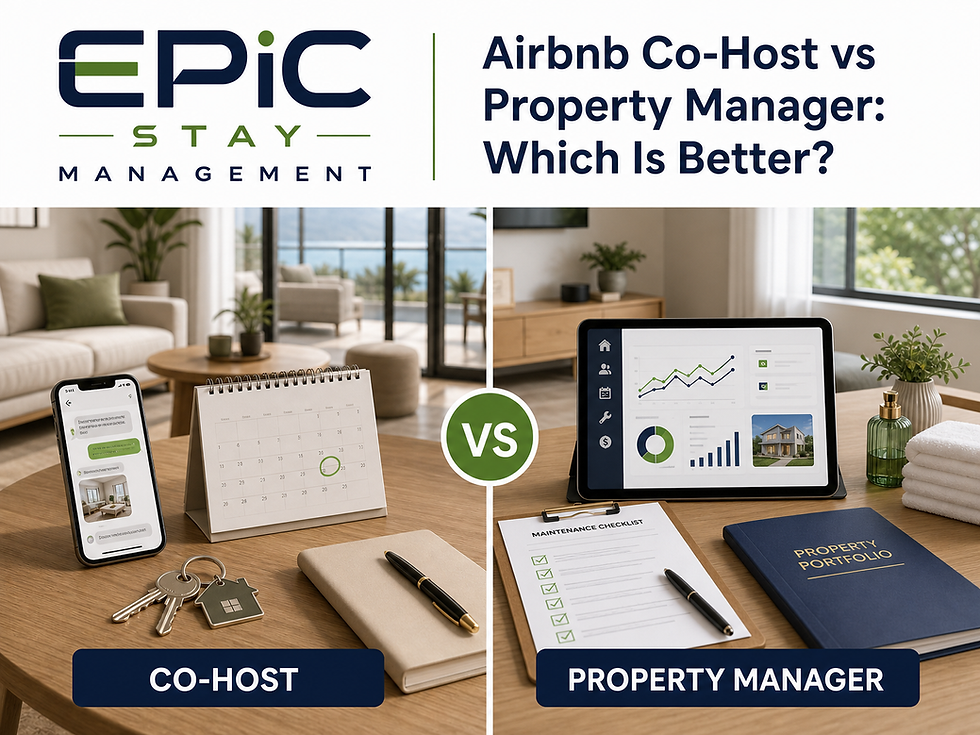
Choosing between an Airbnb co-host and a property manager sounds simple until an owner begins comparing actual responsibilities. One candidate may call the service co-hosting but offer complete listing, guest, cleaning, maintenance, and pricing oversight. Another may use the title property manager while limiting the agreement to messages and calendar work. The label alone does not tell you who will answer a lockout at 11:30 p.m., inspect the home after a difficult stay, approve an emergency plumber, reconcile cleaner invoices, or explain a weak month to the owner.
The practical Airbnb co-host vs property manager decision is therefore not a contest between two job titles. It is a decision about authority, accountability, local coverage, operating systems, risk controls, communication, and how much work the owner wants to retain. A good arrangement can be narrow or comprehensive. A bad arrangement is one in which the owner assumes a responsibility is covered and discovers during a guest problem that it is not.
Epic Stay Management provides full-service short-term and mid-term rental oversight for owners in Indianapolis and Central Indiana. This guide explains how co-hosting differs from professional property management, where the two models overlap, which questions expose the real service scope, and how to choose an operating partner without relying on titles or promises.
Own a furnished rental and need a clearer operating plan? Request a call with Epic Stay Management to discuss the property, current workload, and management fit.
Quick Answer: Is a Co-Host or Property Manager Better?
A co-host may be the better fit when an owner needs selected Airbnb tasks handled, wants to stay closely involved, already has reliable cleaners and maintenance vendors, and is comfortable serving as the final decision-maker. A property manager may be the better fit when the owner wants one accountable operator coordinating the listing, guests, pricing, cleaning, property care, vendors, reporting, and after-hours response.
There is no universal winner. Airbnb allows co-hosts to receive different levels of platform access, and its Co-Host Network includes providers offering either individual services or full support. That means a capable professional co-host can perform work that looks very similar to full-service management. Conversely, a management agreement can be limited. The correct comparison is the written scope, not the business card.
For most owners seeking genuinely hands-off ownership, the stronger model is the one that creates end-to-end responsibility. The manager or co-host should be able to explain who owns each step of the guest journey, what happens when the normal plan fails, and how the owner will know the property was handled correctly.
What Is an Airbnb Co-Host?
An Airbnb co-host is a person the listing owner authorizes to help operate an Airbnb listing. Airbnb explains that a co-host may be a family member, friend, neighbor, or a hired professional. The listing owner can select permissions for each person, and Airbnb currently allows up to ten co-hosts on a home listing. See Airbnb’s official guidance on adding co-hosts to a home listing.
Co-host is a platform role
The most precise way to understand the term is that co-host describes access and collaboration inside Airbnb. It does not, by itself, define an entire property-management business. The platform role can give someone visibility into the listing and the ability to perform approved actions, but the owner and co-host still need a separate understanding of what work will actually be performed at the home and outside the platform.
Airbnb offers different permission levels
Airbnb’s current co-host permission framework includes full access, calendar and messaging access, and calendar access. Full-access co-hosts can manage major listing functions such as messages, calendar, pricing, listing details, reservations, certain reimbursement requests, and permissions for other non-full-access co-hosts. More limited permission levels restrict what the co-host can see and change.
Platform permissions are important because they define technical authority. They do not automatically create cleaning coverage, maintenance response, inspection procedures, bookkeeping, vendor accountability, supply management, or a local emergency plan. Those duties must be assigned in the service agreement or operating plan.
Co-hosting can be narrow or full service
Airbnb’s Co-Host Network distinguishes between custom support and full support. A custom-support provider may handle only selected responsibilities. A full-support provider may offer listing setup, pricing and availability, booking requests, guest messaging, onsite support, cleaning and maintenance, and photography. Airbnb’s own description confirms why owners should not assume that “co-host” always means part-time help.
A co-host might therefore be a trusted neighbor who helps with check-ins, an experienced host who manages messages and pricing, a cleaner who also reports damage, or a professional company delivering broad operational support. The owner must identify which version is being offered.
What Is a Short-Term Rental Property Manager?
A short-term rental property manager is a person or company engaged to coordinate the business and property operations of a furnished rental. The relationship is usually defined by a management agreement rather than by one booking platform’s permission settings. The manager may still be added as an Airbnb co-host because that is the practical way to access the listing, but the contractual scope can extend far beyond Airbnb.
Full-service short-term rental management commonly includes listing strategy, calendar and rate oversight, guest communication, cleaning coordination, inspections, supply control, vendor dispatch, maintenance escalation, review response, owner reporting, and recommendations about the property. Depending on the agreement, it may also include onboarding, photography coordination, platform distribution, smart-lock administration, mid-term stay procedures, and support for owner bookkeeping.
Property management is an accountability model
The core value is not simply the number of tasks. It is the presence of a defined operator who coordinates those tasks as one system. When a guest reports no heat, the issue may involve guest communication, thermostat troubleshooting, vendor dispatch, spending authority, schedule changes, documentation, and owner notification. A full-service manager is expected to connect those actions rather than leave the owner to coordinate several independent providers.
The title still does not guarantee full service
Property manager is not a substitute for reading the agreement. Some firms exclude maintenance coordination, after-hours support, inspections, restocking, linen management, or extended-stay work. Some charge separately for those services. Owners should compare the actual responsibilities, response standards, authority limits, and exclusions.
Why the Two Models Overlap
The overlap exists because Airbnb co-hosting has evolved from informal help into a broad professional-service category. Airbnb’s network allows providers to advertise extensive hosting support, and Airbnb’s terms describe the network as a place where hosts can connect with local service providers, including property managers, cleaners, maintenance providers, and guest-service providers. Airbnb also states that it is not a party to the owner’s separate agreement with the provider. Review the Co-Host Network terms for the current platform language.
In practice, a professional manager may use co-host tools to perform management work. A professional co-host may build a team and deliver management-level service. The distinction becomes meaningful only after the owner examines five things: contractual scope, platform authority, local physical coverage, operating infrastructure, and final accountability.
This is why owners should avoid a simplistic assumption that co-hosting is cheap and limited while property management is expensive and comprehensive. Either model can be well designed or poorly designed. The agreement and execution determine the result.
Airbnb Co-Host vs Property Manager: Side-by-Side Comparison
Decision Area | Co-Host Model | Property Manager Model | What the Owner Must Verify |
Platform access | Usually added directly to the Airbnb listing with selected permissions. | Often added as a full-access co-host or connected through management software. | Who controls the listing, calendar, messages, pricing, payouts, and account data? |
Service scope | May cover one task, several tasks, or full support. | Often broader, but exclusions vary by contract. | Is every recurring duty assigned in writing? |
Local response | May or may not include onsite coverage. | Usually expected in a local full-service model. | Who responds physically, within what time, and with what backup? |
Cleaning and turns | Could schedule cleaners or leave cleaning to the owner. | Commonly coordinates schedule, standards, verification, and escalation. | Who confirms the home is guest-ready? |
Maintenance | May report issues without dispatching vendors. | Often triages and coordinates approved repairs. | What spending authority, markups, and documentation apply? |
Reporting | May provide informal updates or platform-only visibility. | Often includes structured owner reporting. | Which metrics, expenses, incidents, and recommendations are reported? |
Continuity | Can depend heavily on one individual. | May have team coverage and operating procedures. | What happens during illness, vacation, or simultaneous emergencies? |
Owner workload | Usually remains higher when scope is limited. | Can be lower when responsibility is comprehensive. | Which decisions and tasks still return to the owner? |
The table is a starting point, not a verdict. A sophisticated co-host may outperform a weak management company in every category. A strong manager should be able to demonstrate systems, not merely claim that everything is handled.
The 11 Operational Differences That Matter Most
1. Listing ownership and account control
The owner should understand who owns the Airbnb account, who is listed as the listing owner, who appears as the primary host, and what happens to photos, descriptions, message templates, reviews, and future reservations if the relationship ends. A co-host arrangement generally keeps the listing under the owner’s account while granting access. A manager may use the same structure or propose another account arrangement.
Owners should preserve access to performance data and understand the transition procedure before work begins. A smooth exit should not depend on personal goodwill. The agreement should state how credentials, digital assets, reservations, guest communications, and financial records will be handled.
2. Decision authority
Limited authority can protect the owner from unwanted decisions, but it can also slow response. Broad authority can improve speed, but it requires trust and clear controls. The agreement should define which discounts, refunds, repair expenses, reservation changes, cancellations, and guest concessions can be approved without contacting the owner.
The best structure is neither unlimited discretion nor constant owner approval. It is a written authority matrix: routine decisions handled by the operator, larger or unusual decisions escalated to the owner, and true emergencies handled under a defined safety and property-protection standard.
3. Guest communication coverage
Guest communication is more than answering inbox messages. It includes inquiry conversion, screening questions, pre-arrival instructions, access troubleshooting, neighborhood expectations, maintenance updates, checkout reminders, and post-stay follow-up. Owners should ask whether coverage is continuous, after-hours, weekend, and holiday support or merely a daytime response service.
A co-host with calendar and messaging access may handle this well. A property manager may also fail if messages rotate among people without context. Quality depends on response standards, escalation rules, property knowledge, and whether the person replying can coordinate the physical solution.
4. Pricing and calendar management
Pricing support should address base rates, day-of-week patterns, lead time, minimum stays, event periods, gap nights, discounts, owner blocks, cancellation settings, and far-future availability. Software can assist, but an owner still needs a person accountable for reviewing the recommendations and understanding the property’s strategy.
Ask whether the provider merely installs a pricing tool or actively manages it. Also ask who monitors booking pace and who changes the plan when the property is underperforming. Neither a co-host nor a property manager can guarantee occupancy or revenue, but each should be able to explain the decision process without disclosing vague claims about “maximization.”
5. Cleaning and turnover control
Cleaning is a frequent dividing line. A limited co-host might add the cleaner to the calendar and assume the job is complete. A broader operator should manage property-specific checklists, linen capacity, supply levels, cleaner confirmations, photo documentation, damage escalation, quality failures, and backup coverage.
The owner should ask one direct question: who makes the final guest-ready decision? A cleaner can report completion, but someone must determine whether the home is clean, functional, stocked, accurately staged, and safe for the incoming guest. For a deeper discussion of the workload surrounding each reservation, see Why Indianapolis Airbnb Owners Burn Out.
6. Maintenance and emergency response
A platform role does not repair a property. The operating partner needs vendor relationships, troubleshooting procedures, spending limits, documentation, and a method for coordinating access. Owners should distinguish between “we notify you” and “we coordinate the resolution.” Both can be legitimate service models, but they create very different owner workloads.
The provider should also explain what happens when the preferred vendor is unavailable, a repair overlaps with a same-day turnover, or the problem may require moving a guest. Emergency response is an operating system, not a phone number.
7. Inspections and property condition
A listing can receive positive guest messages while the physical asset gradually deteriorates. Managers and co-hosts should clarify whether they conduct routine inspections, turnover checks, seasonal reviews, or only enter the property after a complaint. They should also explain how findings are documented and prioritized.
Owners need visibility into slow leaks, worn linens, loose furniture, pest evidence, damaged cookware, HVAC concerns, exterior issues, and recurring guest misuse. A manager who coordinates inspections may protect the owner’s attention even when no urgent repair is required.
8. Supplies, linens, and inventory
Supply systems rarely appear in sales presentations, but they affect guest readiness and cost control. Toilet paper, trash bags, soaps, coffee supplies, batteries, light bulbs, towels, sheets, mattress protectors, and replacement items need storage rules and reorder points.
Ask who purchases supplies, whether charges carry a markup, how inventory is counted, and who notices abnormal consumption. A narrow co-host may leave this with the owner. A full-service operator should be able to explain the process and the owner’s approval limits.
9. Reporting and financial visibility
Airbnb provides platform statements, but platform statements are not a complete operating report. Owners may also need cleaning expense, maintenance spending, supply cost, refunds, guest credits, occupancy context, rate changes, upcoming risks, and recommendations. A professional report should help the owner make decisions rather than merely repeat gross revenue.
The agreement should specify report frequency, access to invoices, expense approval, and how questions are handled. A provider who cannot explain a month clearly is not providing full operational visibility.
10. Team depth and backup coverage
An individual co-host may provide excellent personal service, yet create concentration risk. A company may have more people, yet deliver impersonal or fragmented service. Owners should evaluate the actual coverage model: who is primary, who is backup, how knowledge is shared, and who has authority during an absence.
The right structure depends on the property. A simple unit with stable vendors may work well with one experienced co-host. A larger home, multiple listings, frequent same-day turns, or an out-of-state owner may benefit from documented team coverage.
11. Contract, insurance, and compliance support
Neither title automatically means the provider is licensed, insured, qualified for every task, or responsible for legal compliance. Airbnb’s Co-Host Network terms place responsibility on the host to verify required permits, licenses, insurance, and qualifications. Owners should conduct the same due diligence for any management company.
The operating agreement should identify each party’s responsibilities for permits, taxes, association rules, insurance, safety devices, occupancy rules, and recordkeeping. A provider can coordinate operational steps, but the owner should obtain legal, tax, insurance, and licensing advice from qualified professionals.
When a Co-Host May Be the Better Choice
A co-host arrangement can be efficient when the owner wants targeted assistance rather than complete delegation. It can preserve owner control, keep the operating structure simple, and fill a specific capability gap without replacing systems that already work.
The owner lives nearby and can handle physical emergencies.
The owner already has reliable cleaners, maintenance vendors, and supply routines.
Only guest messaging, calendar administration, or pricing support is needed.
The owner enjoys hospitality and wants to remain the principal decision-maker.
The property has low operational complexity and limited turnover pressure.
The owner wants to test delegation before moving to full-service management.
A trusted person has detailed property knowledge and clearly defined availability.
The risk is scope drift. A co-host may gradually become responsible for work that was never priced, documented, or supported. The owner should still use a written agreement, even with a friend or family member. It should address duties, permissions, compensation, expenses, confidentiality, guest data, emergency authority, and termination.
When a Property Manager May Be the Better Choice
Professional management may be the stronger fit when the owner wants one operating system rather than several independent helpers. This is especially relevant when the owner is out of town, has a demanding career, owns multiple properties, or is already experiencing the interruptions described in Self-Managing vs. Hiring a Professional Airbnb Property Manager.
The owner wants daily operations handled with minimal involvement.
The home requires coordinated guest, cleaner, maintenance, and inspection coverage.
After-hours issues must be handled without waiting for the owner.
The owner needs structured reporting and documented expense controls.
Multiple properties require consistent standards and portfolio visibility.
The current listing has recurring communication, cleaning, pricing, or maintenance problems.
The property may shift between short-term and mid-term strategies.
The owner wants a local accountable party rather than a collection of separate vendors.
Management is not automatically profitable or appropriate. The fee must be evaluated against service scope, owner workload, operating quality, and expected net income. A property with weak economics does not become a strong investment merely because it is professionally managed.
Could a Full-Service Co-Host Be Functionally the Same as a Property Manager?
Yes. A full-service co-host can be functionally similar to a short-term rental property manager when the provider has broad platform permissions, a written agreement, local vendor and emergency coverage, cleaning and inspection systems, maintenance authority, reporting, insurance, and a clear accountability structure.
The reverse is also true: a company using the title property manager may provide only limited digital support. Owners should score providers by capabilities. The title can help describe the relationship, but it should never replace due diligence.
A useful test is to remove the labels and describe the work in plain language. Who changes rates? Who answers guests? Who schedules and verifies cleaning? Who notices property damage? Who dispatches vendors? Who pays invoices? Who reports to the owner? Who acts when two problems happen at once? The answers reveal the real model.
A Hybrid Model Can Work—But Only With Clear Boundaries
Some owners use a hybrid structure: one person handles platform messages and pricing, a cleaner manages turnovers, the owner approves maintenance, and a local contact responds onsite. This can reduce fees and preserve control. It can also create coordination gaps when responsibilities overlap or no one owns the final outcome.
A hybrid model needs a responsibility map. Each recurring task should have one primary owner, one backup, a response standard, and an escalation path. Shared responsibility often becomes unowned responsibility. The owner should also decide who maintains the master calendar and who communicates changes to every provider.
How Co-Hosts and Property Managers Charge
Pricing structures vary widely. A co-host may charge a flat amount per reservation, an hourly or task fee, a monthly retainer, a percentage of booking revenue, or a combination. A property manager often charges a percentage-based management fee, but may also use a fixed monthly fee or tiered structure. Either model may have separate onboarding, photography, inspection, maintenance coordination, linen, software, or supply charges.
The percentage alone is not a complete comparison. Owners should identify the revenue base used for the calculation. Is the fee based on gross booking revenue, accommodation revenue before taxes, collected rent, owner payout, or another definition? Also determine how cancellations, refunds, cleaning fees, pet fees, and platform adjustments are treated.
The better financial question is: what service is included, what remains with the owner, and what is the expected owner net after all operating costs? A lower fee can be expensive if it creates preventable refunds, missed messages, cleaner failures, or owner time demands. A higher fee can also be poor value if the provider lacks systems or local accountability.
The Management Agreement Should Answer These Questions
Which listings, properties, and booking channels are covered?
Who owns and controls the listing accounts, photos, descriptions, reviews, and data?
What Airbnb permission level will the provider receive?
Which guest communication hours and response standards apply?
Who sets rates, minimum stays, discounts, and owner blocks?
Who schedules cleaning, verifies completion, and handles quality failures?
Who supplies linens and consumables, and how are purchases approved?
Who conducts inspections, how often, and how are findings documented?
Who coordinates maintenance, and what spending can occur without owner approval?
What after-hours and emergency coverage is included?
Which fees, markups, reimbursements, and pass-through costs apply?
What reports, statements, invoices, and performance reviews will the owner receive?
What insurance and qualifications does the provider maintain?
Which compliance tasks belong to the owner and which are operationally supported?
How are damage claims, refunds, chargebacks, and guest disputes handled?
How can either party terminate, and what happens to future reservations?
How are owner and guest data protected after the relationship ends?
Owners should ask for examples, not assurances. “We handle maintenance” should lead to questions about vendor dispatch, approval thresholds, invoice access, after-hours labor, and markups. “We manage cleaning” should lead to questions about checklists, backups, inspections, and damage reporting. Specific procedures are more useful than broad promises.
How to Interview a Co-Host or Property Manager
Ask for the operating map
Request a step-by-step explanation of what happens from inquiry through checkout and turnover. Listen for named responsibilities, verification points, escalation rules, and backup coverage. A provider should be able to explain the normal process and the failure process.
Use scenario questions
Ask what happens when the cleaner cancels on a same-day turn, the smart lock fails after midnight, a guest reports water near the furnace, or an owner blocks a date that is already booked. Scenario questions expose whether the provider has judgment and procedures or only general sales language.
Review actual reporting
Ask to see a redacted sample owner report, maintenance record, inspection checklist, or turnover confirmation. The purpose is not to obtain proprietary strategy. It is to confirm that the promised systems exist and that the owner will receive usable information.
Check references and current work
Speak with owners whose properties resemble yours in size, market, and operating complexity. Ask about communication when something went wrong, not only when bookings were normal. References are most valuable when they describe how the provider handles mistakes and pressure.
Verify the transition plan
Discuss onboarding and termination before signing. A reliable provider should explain access, listing changes, vendor handoff, current reservations, owner approvals, and documentation. The absence of an exit plan can create unnecessary risk even when the relationship begins positively.
A Practical Owner Scorecard
Category | Weight | Questions to Score |
Scope clarity | 20% | Are duties, exclusions, authority, and service hours explicit? |
Local operations | 20% | Is there dependable onsite, cleaning, inspection, and maintenance coverage? |
Communication | 15% | Are guest and owner response standards defined? |
Systems and backups | 15% | Are procedures documented, and is coverage resilient when the primary person is unavailable? |
Reporting and transparency | 10% | Will the owner receive statements, invoices, incidents, and recommendations? |
Contract and controls | 10% | Are fees, markups, data access, termination, and spending limits clear? |
Experience and references | 10% | Does the provider have relevant evidence for similar properties and markets? |
Score the provider, not the title. A co-host who earns a strong score may be the correct choice. A property manager who cannot document the operating model should not receive a higher score simply because the company appears larger.
Red Flags in Either Model
Promises of guaranteed occupancy, revenue, reviews, or investment returns.
No written list of included and excluded services.
Unclear account ownership or resistance to owner data access.
No backup cleaner, local responder, or maintenance escalation plan.
Vague answers about after-hours guest issues.
Unexplained maintenance markups or spending authority.
No sample reporting or documentation.
Pressure to sign before reviewing the agreement.
Reliance on automation as the complete operating plan.
Claims that permits, insurance, association rules, or taxes are automatically handled without defining responsibility.
A credible provider should be comfortable discussing limitations. Strong operators know that outcomes depend on the home, location, market, pricing, reviews, condition, competition, regulations, expenses, and owner decisions. They explain the process without pretending to control every result.
Which Model Is Better for a New Airbnb Owner?
A new owner who wants to learn the business may prefer a skilled co-host who handles selected work while teaching the owner. That approach can be useful when the owner has time, lives nearby, and wants direct experience. The owner should still avoid launching before cleaners, access, maintenance, supplies, rules, pricing, and compliance are ready.
A new owner with limited time or no local network may be better served by full-service management. The manager can help build the operating system before the first guest arrives. The owner should still understand the economics and retain visibility. Professional management reduces work; it does not eliminate ownership responsibility.
Owners still planning the property can use The Complete Beginner’s Guide to Starting an Airbnb in Indianapolis to review readiness before selecting a co-host or manager.
Which Model Is Better for an Experienced Owner?
Experienced owners often know exactly where they need help. Some want message and pricing coverage while retaining vendors and financial control. Others want to stop carrying the mental load of every reservation. The right structure should reflect the owner’s current bottleneck, portfolio size, location, and growth plan.
For a portfolio, consistency becomes more important. The owner needs standardized reports, cleaner expectations, property-specific documentation, vendor controls, and account access across listings. A single talented co-host may still work, but the arrangement should not depend entirely on undocumented personal knowledge.
Platform Payouts Do Not Replace an Operating Agreement
Airbnb may allow a listing owner to share payouts with an eligible co-host, but a payout setting is not a complete compensation agreement. It does not necessarily address reimbursable expenses, cleaner invoices, maintenance charges, cancellations, refunds, direct bookings, reservations from other platforms, or work performed when a property is temporarily unavailable.
Owners should document how compensation is calculated, when it is earned, what happens after a reservation changes, and which expenses are paid separately. The agreement should also explain whether the provider receives payment through Airbnb, by invoice, through management software, or through another method. The payment route should match the accounting records so the owner can reconcile revenue and expenses.
A percentage payout may appear simple, but simplicity can hide ambiguity. Owners should confirm whether the percentage applies to accommodation revenue, cleaning fees, pet fees, taxes, platform adjustments, or other receipts. They should also understand whether the provider can view payout history and whether removing platform access affects any unpaid compensation.
The First 30 Days Should Prove the Operating Model
The beginning of the relationship is when promises become procedures. A structured onboarding period helps the owner and provider confirm access, property readiness, responsibilities, and communication before a preventable problem reaches a guest.
Week 1: access, documentation, and risk review
The provider should review listing ownership, co-host permissions, calendars, future reservations, message history, house rules, access systems, Wi-Fi, utilities, appliance information, parking, trash, emergency contacts, warranties, and known maintenance issues. The owner should disclose prior guest complaints and any unresolved association, insurance, tax, or permit questions.
Week 2: cleaning, inventory, and vendor readiness
The team should walk the home with the property-specific turnover standard, count linen capacity, identify supply storage, test the cleaner schedule, and confirm backup coverage. Maintenance vendors should understand access procedures, approval limits, invoice requirements, and the person authorized to dispatch work.
Week 3: pricing, messages, and guest journey
The provider should review rates, minimum stays, discounts, blocked dates, event periods, cancellation settings, and booking lead time. Scheduled messages and arrival instructions should be tested from the guest’s perspective. Directions, parking, lock instructions, sleeping arrangements, and house rules should match the actual property.
Week 4: reporting and exception testing
The owner should receive the first operating report and confirm that revenue, expenses, incidents, maintenance, cleaner issues, and upcoming risks are understandable. The provider should also walk through exception scenarios: a same-day cleaner cancellation, failed lock, HVAC complaint, guest refund request, and owner-use request. The goal is to identify gaps while they can still be corrected deliberately.
A successful first month does not require every reservation to be perfect. It requires clear ownership of the work, accurate information, prompt escalation, and evidence that the systems function when conditions change.
How Owners Search for Help—and What the Search Terms Miss
Owners may search for “Airbnb property management Indianapolis,” “Indianapolis Airbnb management,” “short-term rental management Indianapolis,” or help with Airbnb owner burnout. Those phrases identify a need, but they do not define the solution. Search results may include solo co-hosts, cleaning coordinators, national platforms, traditional property managers, software tools, and local full-service operators.
The owner still needs to translate the search into operating requirements. The right provider is the one whose written scope and demonstrated systems match the property—not necessarily the company using the closest keyword in its headline.
How Epic Stay Management Approaches the Decision
Epic Stay Management focuses on full-service short-term and mid-term rental operations in Indianapolis and Central Indiana. The management conversation begins with the property, the owner’s goals, the current operating condition, and the work the owner wants to retain.
The objective is not to force every property into the same model. A prospective management review considers listing position, pricing approach, guest communication, cleaning, property readiness, maintenance, supplies, access, reporting, and local response. Not every home is accepted, and professional management is not the correct fit for every owner.
Owners comparing co-hosting with full-service management can contact Epic Stay Management with the property address, bedroom and bathroom count, current listing link, recent performance, known problems, and desired level of involvement.
Frequently Asked Questions
Is an Airbnb co-host the same as a property manager?
Not necessarily. Co-host is an Airbnb platform role with configurable permissions. A property manager is usually engaged under a broader operating agreement. A full-service co-host can perform management-level work, and a property manager may also be added as an Airbnb co-host to access the listing.
Can a co-host manage the entire Airbnb?
Yes, when the owner grants appropriate permissions and the service agreement covers full support. The owner should verify onsite response, cleaning, maintenance, inspections, reporting, and backup coverage rather than assuming full access equals full operations.
Can a property manager be an Airbnb co-host?
Yes. Many short-term rental managers use Airbnb’s co-host tools as the platform-access method. The management contract should define the larger relationship, while Airbnb permissions define what the manager can do inside the platform.
Who owns the Airbnb listing?
The listing owner is the person or entity that created and controls the listing account unless another structure is used. Owners should confirm listing ownership, primary-host status, account access, photos, reviews, data, and transition rights in writing before granting access.
Who should receive full-access co-host permissions?
Only a carefully selected person or company whose responsibilities require that authority. Full access can include substantial listing, reservation, reimbursement, and co-host management capabilities. Owners should match permissions to the work and review access when responsibilities change.
Does a co-host handle cleaning and maintenance?
Some do and some do not. Airbnb’s Co-Host Network allows providers to offer individual or full-support services. The agreement should state whether the provider only schedules vendors, verifies work, dispatches repairs, purchases supplies, or takes broader responsibility.
Which option is cheaper?
There is no universal answer. Limited co-hosting may cost less because the owner retains more work. Full-service co-hosting and property management may use similar pricing structures. Compare total fees, exclusions, pass-through costs, owner time, and expected net income.
Who handles emergencies?
The contract should identify the after-hours responder, onsite coverage, backup person, spending authority, vendor process, and owner-notification rules. Never assume emergency coverage is included merely because the provider answers guest messages.
Can I keep control of pricing and calendar decisions?
Yes, if the agreement reserves those decisions to the owner. However, constant owner approval can slow operations. Many owners use written pricing guardrails, blocked-date procedures, and escalation thresholds so routine decisions can be made efficiently.
What happens when the relationship ends?
The agreement should address notice, future reservations, platform access, guest messages, photos, documents, vendor information, owner data, payouts, and outstanding expenses. Airbnb permissions should be removed promptly when the provider no longer needs access.
Does hiring a manager guarantee higher revenue?
No. Revenue, occupancy, reviews, and investment performance cannot be guaranteed. Professional management may improve execution and reduce owner workload, but results depend on the property, market, pricing, competition, expenses, regulations, and guest behavior.
Do Indianapolis Airbnb owners need a permit?
Indianapolis has adopted a short-term rental permit program. Requirements can change and may vary by property or jurisdiction, so owners should verify current city, county, state, association, insurance, tax, and platform requirements before operating.
Related Resources
Important Disclaimer
This article is general educational and marketing information. It is not legal, tax, accounting, investment, insurance, zoning, licensing, association, building-code, safety, or real estate brokerage advice. Short-term and mid-term rental requirements, taxes, platform rules, insurance coverage, neighborhood restrictions, and association policies can change and may vary by property. Owners should verify current requirements with the applicable city, county, the State of Indiana, their association, insurer, attorney, tax professional, lender, and other appropriate advisors before operating or changing a rental strategy.
Revenue, occupancy, nightly rate, reviews, and investment performance are not guaranteed. Results depend on market demand, property condition, location, amenities, competition, pricing, operating quality, expenses, regulations, guest behavior, and owner decisions.


Comments